From creating chatbots to exploring how technology can protect nature, discover practical resources to bring artificial intelligence, coding and computational thinking into your classroom.
As Europe marks European AI Innovation Month, EU Code Week is inviting teachers and educators to explore how artificial intelligence (AI) can open up new opportunities for creativity, problem-solving and learning.
AI is increasingly part of everyday life, from the tools we use to communicate and create content to the technologies helping us address environmental and societal challenges. For young people, understanding how AI works, how it connects with coding and how to use it responsibly is becoming an important part of digital literacy.
For educators, the challenge is not simply to introduce another technology into the classroom. It is to help students become curious, confident and critical users of AI, while developing the computational thinking and problem-solving skills that underpin digital innovation.
Building on the enthusiasm and creativity of EU Code Week 2026, we are highlighting a selection of practical classroom activities and professional learning resources to support teachers throughout the academic year.
Whether you are introducing AI for the first time or looking to build on existing coding activities, there is something here to help you get started.
Your starting point: EU Code Week’s Learn & Teach resources
The EU Code Week Learn & Teach resource library brings together educational materials, teaching activities and learning opportunities designed to make coding and digital skills accessible to educators and learners.
From unplugged activities that introduce computational thinking without a computer to hands-on digital challenges, the library offers inspiration for different ages, subjects and levels of experience.
For AI Innovation Month, we have selected resources that demonstrate how coding, AI, creativity and real-world problem-solving can work together.
Four practical resources to bring AI into your classroom
The following activities offer different ways to connect digital skills with creativity, sustainability and real-world challenges.
CODE WEEK RESOURCE 01
Every Code Is a Tree, Every Idea Is a Breath!
What if students could use coding and creative thinking to explore how technology can contribute to a greener future?
This resource brings together digital skills and environmental awareness, encouraging learners to explore the relationship between technology, sustainability and the natural world.
It provides an opportunity to connect coding activities with wider classroom discussions about environmental responsibility and how digital innovation can contribute to positive change.
CODE WEEK RESOURCE 02
Smart Educational Bee Park – Technology for Nature
How can technology help us understand and protect the natural environment?
The Smart Educational Bee Park activity invites students to explore this question through a learning challenge focused on nature and technology.
By connecting digital innovation with biodiversity and sustainability, it offers educators an engaging way to bring together STEM learning, environmental education and creative problem-solving.
CODE WEEK RESOURCE 03
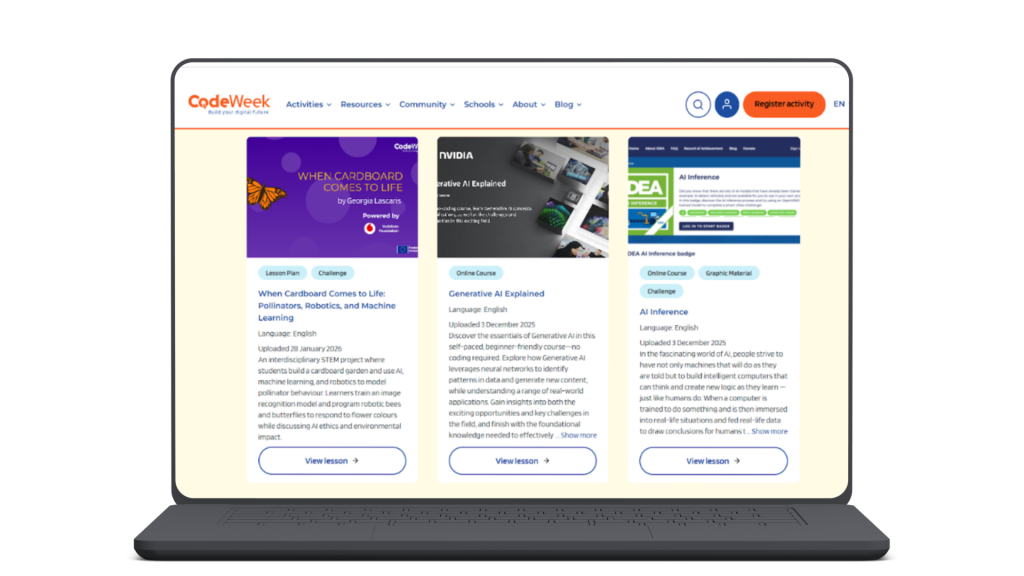
When Cardboard Comes to Life: Pollinators, Robotics, and Machine Learning
AI and robotics do not have to begin with complex equipment or advanced programming knowledge.
This resource combines hands-on creativity with robotics and machine learning, using the theme of pollinators to connect physical making with digital exploration.
It is an example of how educators can introduce emerging technologies through practical, interdisciplinary activities that encourage experimentation, collaboration and curiosity.
About these resources: The three activities above were developed through EU Code Week’s collaboration with the Vodafone Foundation as part of the Digital Educator Awards competition, held between November 2025 and January 2026. Together, they demonstrate how coding, AI and sustainability can be explored through activities that combine unplugged learning, digital tools and physical experimentation.
QUICK CLASSROOM CHALLENGE
Create Your Own Chatbot in 10 Minutes
Looking for a short, engaging way to introduce students to conversational AI?
The Create Your Own Chatbot in 10 Minutes challenge provides a practical starting point for exploring chatbot technology.
It can also open up valuable classroom conversations about how chatbots respond to questions, what makes their responses useful and why it is important to evaluate AI-generated information critically.
Build your confidence: AI learning resources for educators
Introducing AI into teaching does not mean that educators need to become AI experts overnight.
Understanding the fundamentals, recognising the opportunities and limitations of AI, and knowing how to guide students towards responsible use are valuable first steps.
Alongside EU Code Week’s classroom resources, we have selected seven learning opportunities from educational organisations and partners that can help teachers develop their knowledge and confidence.
Understanding AI and its applications
iDEA: What Is AI?
An introductory learning badge designed to help learners develop an understanding of artificial intelligence. A useful starting point for educators who want to familiarise themselves with the basic concepts before introducing them in class.
Introduction to Artificial Intelligence – Library of Open Educational Resources
An open educational resource from Finland that offers another entry point for exploring AI concepts and supporting learning about the technology.
HP LIFE: AI for Beginners
An introductory course for those looking to build a foundational understanding of artificial intelligence and its applications.
Developing practical knowledge and teaching skills
Cisco: AI Fundamentals with IBM SkillsBuild
For educators interested in developing their technical understanding, this learning opportunity introduces key AI concepts and helps build knowledge of the technologies behind AI applications.
HP AI Teacher Academy
Designed with educators in mind, this professional learning opportunity supports teachers in exploring AI and considering how it can be applied in educational settings.
EY AI Skills Passport
A learning initiative focused on developing AI knowledge and skills, offering an additional opportunity for educators and learners to explore AI literacy and its relevance to the changing world of work.
Putting responsible AI at the centre
Ethical AI in Education
As AI becomes more common in education, it is essential to consider how it is used and the impact it can have on learners.
This resource provides a starting point for exploring ethical considerations and encouraging thoughtful, responsible approaches to AI in educational contexts.
From understanding AI to creating with it
One of the most valuable ways to introduce AI to young people is to move beyond simply using AI-powered tools and encourage them to explore the ideas and processes behind the technology.
Coding and computational thinking provide an important foundation for this exploration.
When students learn to break problems into smaller steps, recognise patterns, develop algorithms and test solutions, they build skills that can help them better understand how digital systems work.
Combining these foundations with AI-related activities creates opportunities for students to ask questions, experiment, collaborate and think critically about the technologies shaping their lives.
It also encourages important discussions:
- How does an AI system learn?
- Can its answers always be trusted?
- What happens when technology makes mistakes?
- How can we use AI in ways that are fair, safe and beneficial?
These conversations are just as important as the technical skills themselves.
Keep learning, creating and exploring with EU Code Week
Although the main EU Code Week 2026 campaign has concluded, the opportunity to inspire digital creativity continues throughout the school year.
European AI Innovation Month is an opportunity to explore new approaches, revisit classroom activities and help young people develop the skills they need to navigate an increasingly AI-powered world.
You do not need specialist equipment or extensive technical knowledge to begin. A simple coding challenge, a discussion about responsible AI or a creative project connecting technology with a real-world issue can be a meaningful starting point.
Ready to bring AI, coding and creativity into your classroom?
Discover teaching materials, classroom challenges and learning inspiration in the EU Code Week Learn & Teach resource library.
Together, we can help the next generation become not just users of technology, but confident, creative and responsible digital citizens.
