EU Code Week 2026 | Event Highlights
The Future Is Now: Building Europe’s Digital Future Together
From closing Europe’s digital skills gap to inspiring the next generation of technology creators, The Future Is Now brought together policymakers, industry leaders, educators and the EU Code Week community in Brussels to explore how collaboration can shape Europe’s digital future.
14 October 2026 | Brussels, Belgium
Europe’s digital future will depend as much on the people who develop, teach and use technology as on the technology itself. That was the message running through The Future Is Now, a major EU Code Week event held at Comet Louise in Brussels on 14 October 2026. Bringing together representatives from European institutions, industry, education and civil society, the event examined how Europe can respond to rapidly changing digital skills needs while ensuring that people of all ages and backgrounds have an opportunity to participate.
Taking place during EU Code Week 2026 and as part of European Skills & VET Week, the event was also an opportunity to reflect on the achievements of Code4Europe, the European Union-funded initiative working to strengthen EU Code Week and expand its reach across the continent. Over two years of collaboration, the project has brought together organisations and communities committed to making coding, computational thinking and digital skills education more accessible. The discussions in Brussels celebrated that progress, but also asked a more challenging question: how can the connections established through projects and initiatives like EU Code Week be sustained and translated into lasting change?
The programme explored some of the most pressing issues facing Europe’s digital skills ecosystem, including the impact of artificial intelligence on employment, the growing importance of lifelong learning, the need to encourage more girls and women into technology, and the role of education and industry partnerships. While speakers approached these challenges from different perspectives, there was broad agreement that progress cannot depend on isolated initiatives. Europe’s ambitions will require stronger cooperation between policymakers, employers, educators and the communities delivering digital education on the ground.
Europe’s digital talent challenge: Turning ambition into action
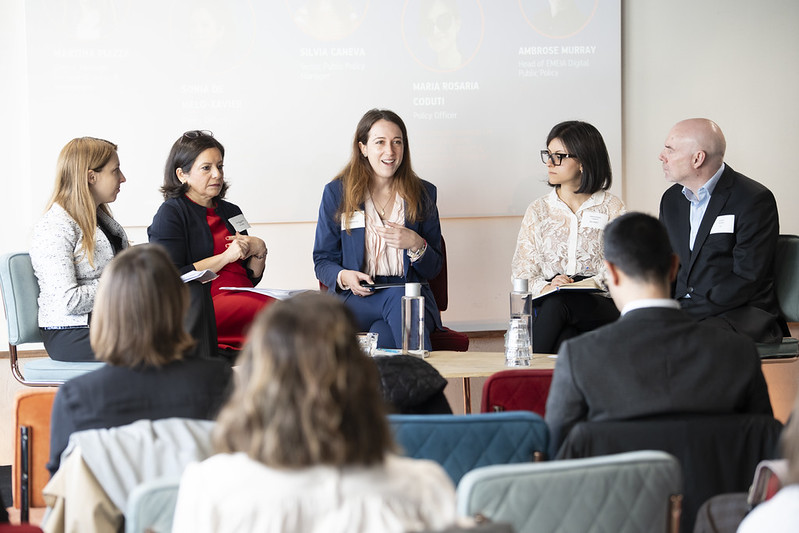
The opening panel, Europe’s Digital Talent Challenge: From Policy Ambition to Industry Action, examined the widening relationship between technological change and the skills needed in Europe’s workforce. Moderated by Martina Piazza, Senior Manager for Investments & Innovation at DIGITALEUROPE, the discussion brought together Sonia de Melo Xavier, Policy Officer at the European Commission’s Directorate-General for Employment, Social Affairs and Inclusion (DG EMPL); Maria Rosaria Coduti, Policy Officer at the Directorate-General for Communications Networks, Content and Technology (DG CONNECT); Silvia Caneva, Senior Public Policy Manager at Workday; and Ambrose Murray, Head of EMEIA Digital Public Policy at EY.
The panel acknowledged that Europe has made important progress in improving digital skills, but the pace of technological development means that the challenge is continually evolving. Artificial intelligence is already changing how organisations operate, reshaping established job roles and creating demand for capabilities that were barely considered a few years ago. Ambrose Murray highlighted the improvements in baseline digital skills while drawing attention to how AI is transforming professional profiles and expectations. Silvia Caneva built on this point from an industry perspective, explaining how demand for specialised digital talent makes continuous learning increasingly important for employers. Recruiting people with new skills is only part of the solution; organisations must also create opportunities for their existing workforce to develop and adapt.
For policymakers, the challenge is to ensure that education, employment and digital transformation policies respond to these developments in a coordinated way. Sonia de Melo Xavier emphasised the value of stronger partnerships and closer dialogue with those experiencing skills challenges directly, while Maria Rosaria Coduti highlighted the potential of European Digital Skills Academies to bring stakeholders together around strategic technologies. The discussion made clear that digital skills should no longer be viewed as the concern of a relatively small group of technology specialists. They are increasingly relevant across almost every sector of the economy, making opportunities for upskilling and reskilling essential for workers, businesses and society.
This need for sustained cooperation was also reflected in the contribution of Helena Lovegrove, Senior Director for Projects at DIGITALEUROPE, whose perspective was featured in the European Commission’s coverage of the event. She highlighted the importance of building long-term connections between industry, education and policymakers so that emerging skills needs can be identified earlier and addressed more effectively. The message was consistent with the opening discussion: Europe’s digital skills ambitions must be supported by practical partnerships that can respond to change, rather than occasional collaboration between organisations.
Inspiring girls to see a future in technology
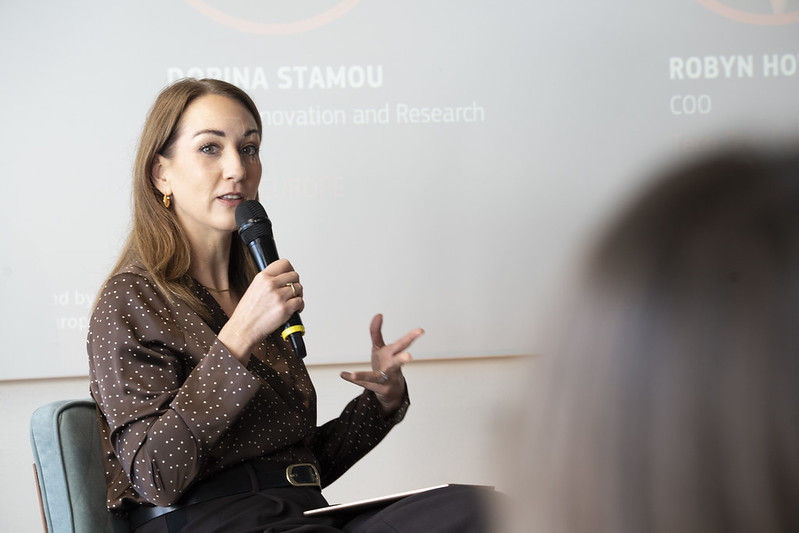
If Europe is to develop the digital talent it needs, it must also address the barriers that prevent some groups from seeing technology as a field in which they belong. This was the focus of a fireside chat between Dorina Stamou, Senior Innovation and Research Manager at DIGITALEUROPE, and Robyn Howard, Chief Operating Officer of Tech She Can, the UK organisation working to inspire children, particularly girls, to explore the possibilities of technology and future careers in the sector.
Drawing on Tech She Can’s experience of reaching thousands of children through classroom activities, Robyn Howard described how attitudes towards technology and career aspirations can begin to form at a remarkably young age. Gender stereotypes, often reinforced unintentionally through everyday experiences and expectations, can influence whether children believe particular careers are open to them. This makes early engagement especially important. By introducing children to technology through creative, accessible and enjoyable learning experiences, educators can help challenge assumptions and encourage young people to see themselves not simply as users of technology, but as people capable of creating and shaping it.
The conversation also explored the importance of visible role models and the influence of the adults around children. Teachers, parents, employers and community leaders can all help broaden young people’s understanding of what a career in technology might involve. Industry has a particularly valuable role to play by showing children the diversity of people, professions and opportunities within the technology sector. The aim is not simply to encourage more girls to study technical subjects, but to ensure that their choices are not limited by stereotypes or a lack of exposure to the possibilities available.
These messages have particular relevance for EU Code Week, which supports educators and community organisations in introducing coding, robotics, computational thinking, artificial intelligence and other digital activities to learners across Europe. Many of these activities provide children with their first opportunity to experiment with technology in a creative and supportive environment. They can spark curiosity, develop confidence and help young people discover interests they might otherwise never have explored. As the discussion in Brussels reinforced, a more inclusive digital future begins long before young people enter higher education or employment.
Two years of Code4Europe: Strengthening a European movement
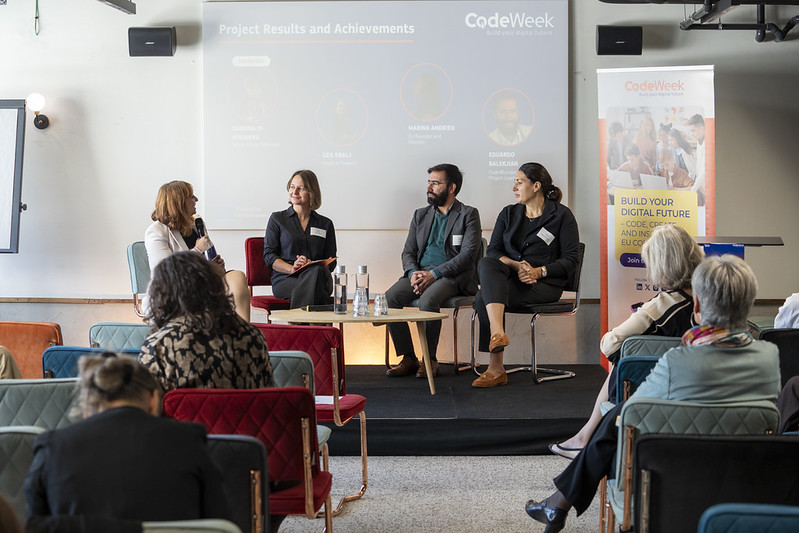
Alongside the discussions about Europe’s wider digital skills challenges, The Future Is Now provided an opportunity to reflect on the achievements of Code4Europe and the continued development of EU Code Week. A panel moderated by Sabrina Di Ruggiero, Senior Project Manager at Schuman Associates, brought together Dea Kralj, Head of Projects at ALL DIGITAL; Eduardo Balekjian, Code4Europe Project Lead at JA Europe; and Marina Andrieu, Co-founder and Director of WIDE ANDCO S.I.S., to discuss the project’s progress and the value of collaboration across the consortium.
Eduardo Balekjian reflected on the remarkable evolution of EU Code Week since its beginnings as an initiative to encourage people to discover coding. Over time, it has developed into a much broader European movement, encompassing digital creativity, computational thinking and the skills needed to participate confidently in an increasingly technology-driven society. That evolution reflects both the changing role of digital technologies in everyday life and the willingness of educators, organisations and volunteers to build on the original idea. What began with a focus on coding has become a platform for bringing people together around a shared commitment to digital education.
The Code4Europe consortium has worked over the past two years to strengthen this movement, develop connections across the digital skills ecosystem and support those bringing EU Code Week activities to life. The discussion highlighted the importance of shared resources, cooperation between organisations and the opportunities created when partners with different areas of expertise work towards common goals. Just as importantly, it emphasised that success should not be measured solely through individual events or participation figures. The relationships built between educators, schools, hubs, businesses and civil society organisations can continue to generate opportunities long after a particular activity or project milestone has passed.
This sense of continuity was central to the panel’s reflections. EU Code Week’s greatest strength lies in its ability to connect European ambitions with the enthusiasm and expertise of people working in local communities. Through these connections, knowledge can be shared, successful approaches adapted and new partnerships developed. The challenge now is to maintain that momentum, ensuring that the progress made through Code4Europe provides a strong foundation for the movement’s future.
The community bringing digital skills to life
The importance of local engagement was explored further in a fireside chat between Eduardo Balekjian of JA Europe and Lotte Buyl, EU Code Week community member and Project Coordinator at Digitale Wolven, the national hub for EU Code Week in Belgium. Their conversation offered a valuable perspective on the people behind the movement and the work taking place beyond European-level discussions and initiatives.
Lotte highlighted the importance of engaging children through opportunities to experiment, explore and discover digital technologies in an environment that encourages curiosity. Activities delivered in schools and communities can make digital learning more approachable, particularly for young people who may have had limited opportunities to engage with technology beyond everyday use. The conversation also emphasised the role of local networks in supporting educators, sharing experiences and helping organisations develop activities that respond to the interests and needs of their communities.
Across Europe, national and regional hubs, Code Week Ambassadors, Leading Teachers and other community members provide the connections that make this possible. They support schools, bring educators together, promote activities and help extend digital learning into places where it can have a meaningful impact. Their work demonstrates that EU Code Week is much more than an annual campaign. Although the October celebrations provide an important focal point, the relationships, resources and enthusiasm generated through the movement can support digital skills education throughout the year.
The discussion was a reminder that Europe’s digital transformation is ultimately experienced at a local level, through the opportunities available to children, teachers, families and communities. European initiatives can provide direction, funding and visibility, but it is the commitment of people on the ground that turns those ambitions into learning experiences. Supporting this community, and ensuring that it continues to grow and share knowledge, will remain essential to EU Code Week’s long-term impact.
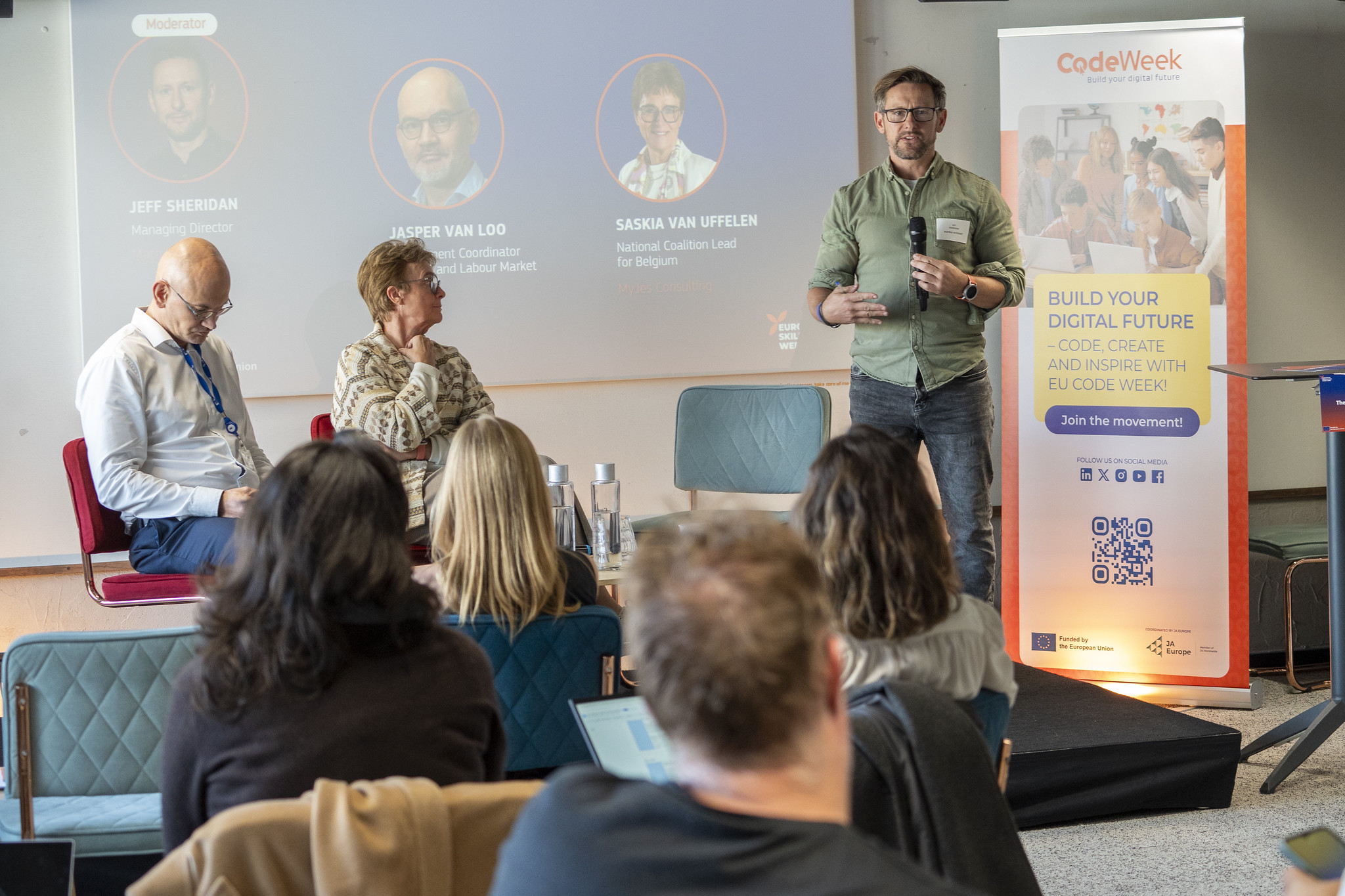
Beyond good intentions: Making industry and education collaboration work
The final panel brought the day’s conversations together around a practical question: what does collaboration between industry and education actually need in order to work? The discussion involved Jeff Sheridan, Managing Director of Matrix Internet; Jasper Van Loo, Department Coordinator for Skills and Labour Market at Cedefop, the European Centre for the Development of Vocational Training; and Saskia Van Uffelen, National Coalition Lead for Belgium at MyJes Consulting. Bringing together perspectives from business, research and skills initiatives, the panel explored what needs to change if Europe is to move from identifying skills shortages to addressing them effectively.
Jasper Van Loo drew on Cedefop’s evidence about changing skills needs and access to training, challenging the assumption that participation alone is an adequate measure of progress. He highlighted that 49% of digital training courses last one week or less, raising important questions about the depth and intensity of learning opportunities. Short courses can play a useful role in introducing new technologies or developing targeted skills, but more substantial learning may be needed to equip people for complex roles and changing professional requirements. Addressing the digital skills gap therefore requires attention not only to the availability of training, but also to its quality, relevance and accessibility.
The discussion also considered how education and employment are changing as people are increasingly required to update their capabilities throughout their careers. Qualifications and skills acquired at one point in time cannot necessarily be expected to remain sufficient in a rapidly evolving labour market. Employers need to recognise learning as an ongoing responsibility, while education and training providers must remain connected to emerging industry needs. Cedefop’s contribution reinforced the importance of evidence in understanding where skills shortages exist, which groups face barriers to training and how learning opportunities can be designed to deliver meaningful outcomes.
Jeff Sheridan brought a business perspective to the discussion, reflecting the importance of collaboration between the organisations developing digital technologies and those responsible for education and skills development. Saskia Van Uffelen, meanwhile, encouraged participants to recognise the progress already being made and to build on successful initiatives rather than continually starting from scratch. This was an important counterpoint to the scale of the challenges being discussed throughout the day. While Europe’s digital skills needs are significant, there are already examples of effective cooperation that can be strengthened, expanded and adapted.
Jasper Van Loo captured the central importance of skills with a simple observation: “At the end of the pipeline, there’s always skills.” The panel’s closing message was one of measured optimism. Building stronger connections between education and industry requires ambition, urgency and long-term commitment, but there is already a foundation on which to build. EU Code Week itself offers an example of how continued investment in a shared initiative can create a network that supports learning, encourages participation and connects organisations across Europe.
A shared European commitment to digital skills
One of the defining features of The Future Is Now was the breadth of organisations represented throughout the discussions. The event brought together perspectives from the European Commission, including DG EMPL and DG CONNECT, alongside DIGITALEUROPE, Cedefop, Workday, EY, Tech She Can, ALL DIGITAL, JA Europe, WIDE ANDCO, Schuman Associates, Digitale Wolven, Matrix Internet and MyJes Consulting. Each organisation contributed a different perspective on the opportunities and challenges involved in preparing Europe for a rapidly changing digital future, from policy development and labour market intelligence to business needs, educational inclusion and community participation.
The European Commission’s contribution connected the discussions to broader European priorities around employment, education and digital transformation, while industry representatives provided insights into how technological developments are changing the skills businesses require. Cedefop’s involvement brought an important research and vocational training perspective, helping to ground the debate in evidence about how people learn and how skills needs evolve. Organisations working directly with educators, young people and local communities demonstrated what these wider ambitions mean in practice, showing how inclusive and engaging digital education can open up opportunities for learners.
The event’s significance was also recognised in an article published on 15 October by the European Commission, Working together to build Europe’s digital future. The coverage reinforced the importance of partnerships, lifelong learning and inclusion, highlighting the need to move from shared ambitions towards sustained action. It also placed the event within the wider European Skills & VET Week, linking the discussions in Brussels with Europe’s broader commitment to developing the skills required for its future economy.
The next chapter for Europe’s digital future
As The Future Is Now drew to a close, several themes had emerged repeatedly throughout the day. Europe’s digital skills challenge is not simply about increasing the number of people with technical qualifications. It is about creating a culture of learning in which individuals can continue to develop their skills as technology changes, ensuring that opportunities are accessible regardless of age or background, and building stronger connections between the organisations responsible for education, employment and digital innovation.
There was also a strong sense that inclusion must remain at the centre of this work. Encouraging girls to explore technology from an early age, making diverse role models visible and supporting teachers and community organisations are not separate concerns from Europe’s economic ambitions. They are fundamental to developing the talent, confidence and creativity needed for the future. Equally, meaningful investment in lifelong learning must consider both the availability of opportunities and whether the training offered is sufficiently relevant and substantial to support people as their careers evolve.
For EU Code Week, the conversations offered both recognition of what has been achieved and a clear direction for what comes next. The movement has grown through the commitment of educators, Ambassadors, Leading Teachers, hubs, partner organisations and thousands of people who believe that digital skills should be accessible to everyone. Code4Europe has helped strengthen the networks and partnerships supporting that ambition, demonstrating what can be achieved when organisations work together towards a common purpose.
The challenge now is to build on that progress. As speakers throughout the event made clear, meaningful collaboration does not happen through one conference, one project or one campaign. It develops through sustained relationships, the willingness to share knowledge and a commitment to turning discussion into practical opportunities. Europe’s digital future will be shaped by the policies and technologies developed in the years ahead, but just as importantly, by the investments made today in the people who will use, create and lead them.
EU Code Week 2026: Be part of the movement
With EU Code Week 2026 taking place from 10 to 25 October, the discussions in Brussels provided a timely reminder of the importance of bringing digital skills into classrooms and communities. Across Europe, educators, schools, businesses and organisations are introducing young people and adults to coding, computational thinking, artificial intelligence and digital creativity through activities designed to make technology engaging and accessible.
Every workshop, classroom lesson and community activity has the potential to spark an interest, build confidence or help someone discover a new opportunity. Whether it is a child’s first experience of creating a computer programme, a teacher exploring new digital tools or a local organisation encouraging more people to take part, these experiences contribute to a broader culture of digital learning.
The Future Is Now demonstrated that the skills challenge facing Europe is considerable, but so too is the collective expertise, enthusiasm and commitment available to address it. By strengthening the connections between education, industry, policymakers and communities, Europe can create more opportunities for people to develop the skills they need and play an active part in shaping the digital world.
The future is not something we simply wait for. It is something we build together.
Get involved in EU Code Week
Whether you are a teacher, student, parent, business or community organisation, there are many ways to take part in EU Code Week. Explore the resources, organise an activity or join Europe’s growing digital skills community.
