How a small community turned coding into a shared experience
10/06/26
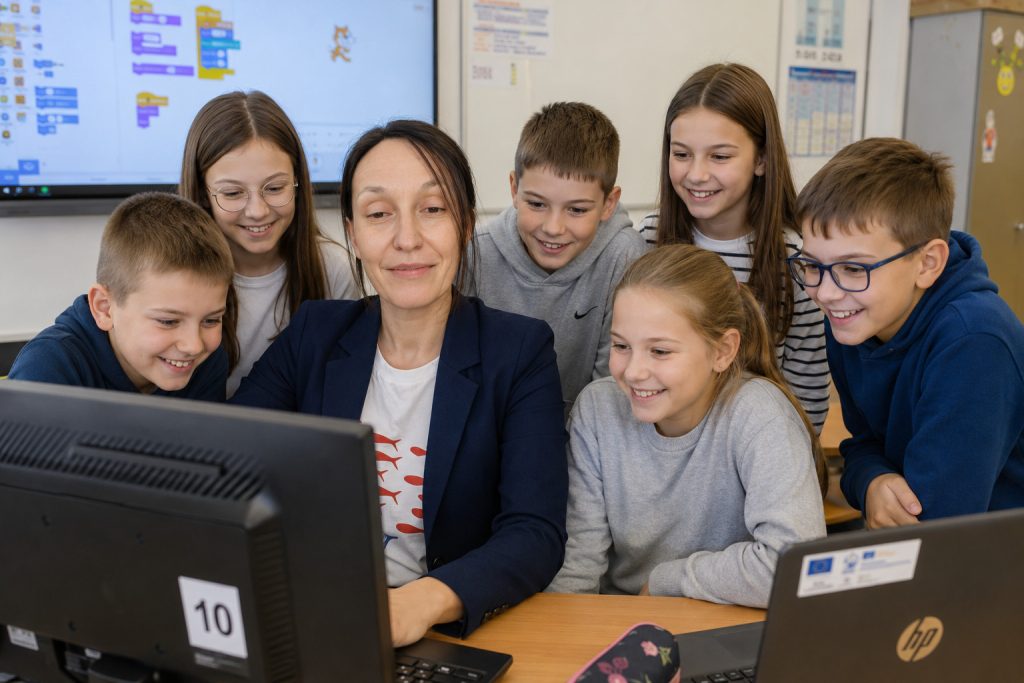
At Primary School “Matija Gubec” in Cernik, Croatia, Kristina Slišurić is helping students discover coding. For her, it is not just a technical skill, but a way to connect people across generations.
Kristina works with children and young people aged 5 to 15 in a small rural community. For them, she designed Code Week activities that were playful, inclusive, and accessible to everyone – from kindergarten pupils and teachers to parents and seniors.
During the project “All of Cernik Codes”, students explored coding through block-based programming, cryptography challenges, dance activities, AI workshops, and hands-on creative tasks.
“One of the most valuable aspects of “All of Cernik Codes” was seeing how different generations became involved in coding and digital activities in ways adapted to them,” Kristina explained.
Rather than organising one activity for everyone, the school created different workshops tailored to each group.
“Younger children explored coding through movement and play, teachers discovered computational thinking through team challenges, and seniors learned how AI tools like ChatGPT can support everyday life.”
Coding brings generations together
One of the activities that generated the most excitement was the “Family Beaver Challenge”. It was an escape-room-style workshop focused on coding and logic puzzles.
“Students loved solving puzzles together with their parents, siblings and even grandparents,” Kristina recalled. “The atmosphere in the school that evening was amazing, full of laughter, teamwork and positive energy.”
For the teacher, these moments showed that coding can create connections far beyond the classroom. “In a small rural community, this kind of participation created a strong feeling of connection and showed that digital learning can truly belong to everyone, regardless of age or experience.”
As a Code Week Ambassador for Croatia, Kristina therefore believes this inclusive approach is one of the initiative’s greatest strengths.
Introducing seniors to AI
Another memorable experience came from a workshop designed specifically for older members of the local community.
During “Smart Conversations – ChatGPT in Your Daily Life”, seniors explored how AI tools could support everyday tasks. For instance, these included writing messages, planning meals, finding information, or even creating poems and images.
“Many participants came with curiosity, but also with some uncertainty about artificial intelligence and modern digital tools,” Kristina said.
What followed surprised even the organisers.
“There was a lot of laughter, discussion, and genuine curiosity. Participants asked creative questions, experimented with AI-generated images, and quickly realised that technology does not have to be intimidating.” For the teaching team, the workshop in turn became a powerful reminder that digital education can help strengthen community ties.
“It was very emotional to see seniors gain confidence and feel included in the digital world,” Kristina told us.
Making coding feel accessible
In smaller communities, Kristina says many students initially see coding as something distant from their everyday lives. Through Code Week, the goal was to change that perception.
“We showed students that coding is not only about complex programming or computers,” she explained. “It can be connected to storytelling, music, art, games, movement, teamwork, and even cryptography.”
By focusing on creativity and collaboration, students began to see coding as something they could genuinely participate in.
“Students gained confidence and realised that everyone can participate and succeed,” Kristina concluded.
