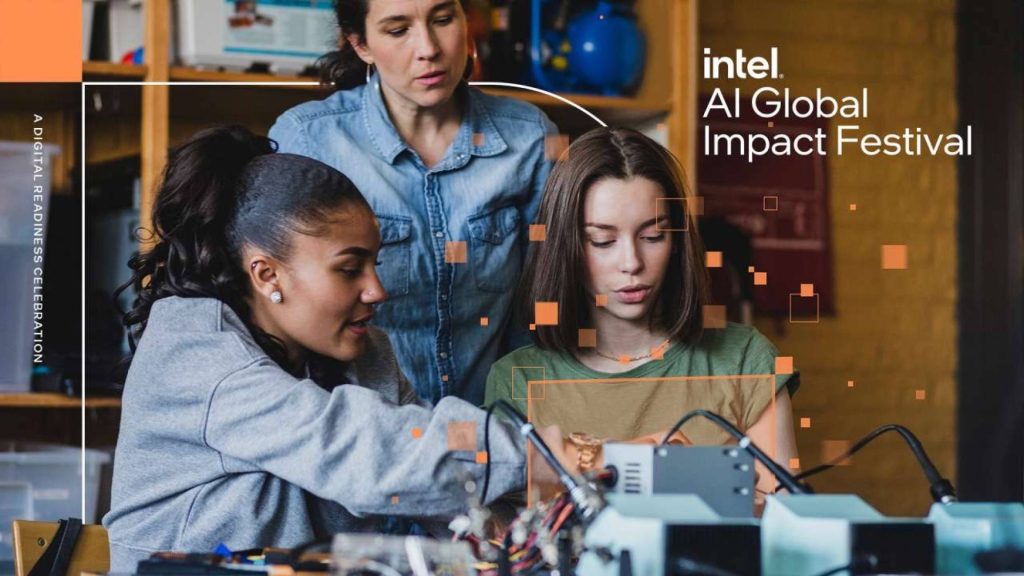
The Festival gives students an opportunity to move from learning about AI to applying it in practical and meaningful ways. Whether they are exploring environmental challenges, accessibility, education, wellbeing or other social issues, participants are encouraged to think about how AI can support real solutions aligned with the Sustainable Development Goals.
A global platform for young AI changemakers
The Intel® AI Global Impact Festival celebrates student-led AI innovation from around the world. Since its launch in 2021, the Festival has welcomed more than 500,000 visitors from over 135 countries, creating a space where young people can share ideas, learn from one another and demonstrate how AI can be used to enrich lives.
For 2026, students can take part in the AI Changemakers global competition. The competition is open to student innovators in two age categories:
- 13–17 years
- 18 years and above
Students may enter individually or as part of a team of up to three students. Submissions must come from active students in a K-12, higher education or vocational education institution.
Why this matters for educators
For teachers, trainers and educators, initiatives like the Intel® AI Global Impact Festival offer a valuable way to connect classroom learning with real-world problem-solving.
AI can sometimes feel abstract for learners, especially when it is presented only as a technical topic. Competitions like this help students see AI as a practical tool that can be used to explore questions, identify challenges, test ideas and develop solutions.
The Festival can support classroom conversations around:
- responsible and ethical AI
- digital creativity
- computational thinking
- teamwork and communication
- problem-solving
- the role of technology in society
- AI careers and future skills
It also gives students an opportunity to present their ideas clearly, reflect on the impact of their work and build confidence in communicating technical concepts to wider audiences.
What students need to prepare
To enter the AI Changemakers competition, students are asked to submit an AI-based project or solution. Each complete entry should include:
- a project or solution title of up to 10 words
- a project description of up to 150 words
- a 2-minute video or vlog
- signed consent forms
- confirmation that the submission comes from an active student or team of students
The video should include a section where the project team speaks directly to the camera. If the video is not in English, English subtitles should be added. AI-generated voiceover is not allowed, and videos longer than two minutes may receive a penalty.
These requirements encourage students not only to build or design an AI solution, but also to explain their thinking, communicate their idea and reflect on its potential impact.
Key dates for 2026
Global nominations open: 1 July 2026
Last date for global nominations: 30 August 2026
Educators and partner organisations interested in supporting student participation are encouraged to start early, giving students enough time to develop their ideas, prepare their submissions and refine their videos.
How the judging process works
The AI Changemakers global competition includes a three-stage judging process.
First, projects are reviewed and selected at country, region or territory level, using the recommended judging criteria. Up to three projects per age category can be nominated from each participating country, region or territory.
Next, nominated projects are reviewed through global external judging.
Finally, shortlisted projects take part in Intel expert judging, which includes live video interviews. Three projects per age group will be announced as Global Award Winners.
This process gives students the chance to have their work reviewed by expert judges and to experience presenting their ideas in a professional setting.
Learning through innovation
One of the most valuable aspects of the Festival is that it encourages students to see themselves as creators of technology, not only users of it.
By developing AI-enabled solutions, students can explore how digital tools can respond to real needs in their communities. They can also develop important transversal skills, including collaboration, communication, critical thinking and ethical awareness.
For EU Code Week, this strongly connects with our mission to make coding, computational thinking and digital literacy accessible, engaging and relevant for all learners. It also supports the wider goal of helping young people understand how digital skills can open pathways to creativity, participation and positive change.
Get involved
Educators, schools, vocational education institutions, universities and youth organisations can use the Intel® AI Global Impact Festival 2026 as an opportunity to inspire students to explore AI in a meaningful way.
Whether students are already experimenting with AI or are just beginning to understand its possibilities, the Festival offers a practical and motivating framework to develop ideas, build confidence and connect digital learning with real-world impact.
Find out more about the Intel® AI Global Impact Festival 2026
