EU Code Week 2026 officially launched on 12 October, bringing together European leaders, educators, industry partners and community members to explore the future of digital skills in the age of artificial intelligence.
Broadcast from Brussels, the event celebrated the people making digital learning accessible across Europe and explored how coding, computational thinking and creativity can help young people build confidence and shape their digital futures.
Under the theme Building Resilience, Connecting & Empowering Communities in the Age of AI, speakers shared practical experiences, new opportunities for educators and a common ambition to make digital education accessible to everyone.
Watch the EU Code Week 2026 Launch Event
EU CODE WEEK 2026
Watch the official Launch Event
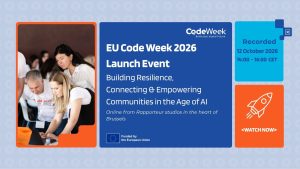
12 October 2026 | Brussels
Europe’s digital future starts with young people
The event opened with a welcome from Diana Filip, Deputy CEO of JA Europe and EU Code Week Lead, followed by video messages from Henna Virkkunen, Executive Vice-President of the European Commission for Tech Sovereignty, Security and Democracy, and Roberta Metsola, President of the European Parliament.
Both highlighted the importance of giving young people the skills to understand emerging technologies and participate confidently in an increasingly digital society.
Henna Virkkunen emphasised the need for responsible AI and the essential role of digital education in preparing Europeans for technological change. She also highlighted the importance of encouraging more girls and young women to explore technology and pursue opportunities in the digital sector.
Roberta Metsola encouraged young people to experiment, develop their ideas and embrace the learning process.
“Be curious, be brave, and don’t be afraid to get it wrong the first time.”
Roberta Metsola
President of the European Parliament
|
Watch at 09:19
The opening contributions reinforced the importance of ensuring that young people are not simply consumers of technology, but have the knowledge and confidence to help shape how it develops.
Why coding matters more than ever in the age of AI
One of the event’s central discussions examined the changing role of coding as artificial intelligence becomes increasingly integrated into education and the workplace.
Representatives from education and industry, including Bebras, SAP and Cisco Networking Academy, explored how the skills developed through coding extend well beyond programming.
Computational thinking, problem-solving, critical evaluation and clear communication are becoming increasingly valuable as people learn to work alongside AI-powered tools. The discussion also highlighted the importance of understanding how technology works, rather than simply accepting its outputs.
Speakers stressed that employers are looking for people who can think independently, experiment confidently, communicate their reasoning and critically assess AI-generated results.
The message was clear: coding education is not becoming less relevant because of AI. It is helping learners develop the understanding and judgement they need to use these technologies responsibly.
The community bringing EU Code Week to life
While technology was a central theme, the people behind EU Code Week remained at the heart of the launch.
Educators, ambassadors and community representatives from Lithuania, Denmark, Belgium, Italy and Germany shared how local initiatives are making digital learning more inclusive and engaging.
Their stories demonstrated the diversity of Code Week activities, from unplugged coding in kindergartens and community library workshops to national hackathons and programmes designed to inspire more girls to pursue STEM.
Nele Steigerwald, EU Code Week Ambassador from Germany, captured the spirit of the initiative:
“It works because people make it their own.”
Nele Steigerwald
EU Code Week Ambassador, Germany
|
Watch at 14:49
Her remarks reflected what makes EU Code Week special. While European partnerships provide support, resources and opportunities to collaborate, it is local educators and communities who transform those opportunities into meaningful learning experiences.
The event also featured a moving contribution from Ukraine, where the Code Week community continues to create opportunities for digital learning despite the challenges of war, disruption and interrupted access to electricity.
These stories were a powerful reminder that digital education is about connection, resilience and opportunity as much as technology.
From first experiences to lifelong digital learning
Looking towards the future, speakers explored how EU Code Week can continue to grow and help address Europe’s digital skills gap.
The discussion highlighted the importance of supporting teachers, connecting education with industry and creating pathways that allow young people to build on their first experiences with coding.
One particularly inspiring contribution came from Joséphine, a young participant from Belgium who described her journey from attending coding activities to volunteering and helping other children discover technology.
Her experience demonstrated the lasting value of introducing young people to digital skills in a supportive environment. A single activity can spark an interest, but continued access to learning opportunities helps that interest develop into confidence, skills and potentially future careers.
Participants also stressed that not everyone who learns to code needs to become a programmer. Problem-solving, teamwork and critical thinking are valuable in almost every profession.
New opportunities with Minecraft Education
The launch also introduced exciting opportunities for schools through Minecraft Education, developed in collaboration with the Microsoft Ireland Dream Space team.
Educators can explore four on-demand Minecraft Education playalongs focused on AI literacy: Generation AI, AI for Earth, Cyber AI and Fantastic Fairground. The programme also includes teacher training resources to help educators confidently introduce Minecraft Education into their classrooms.
A new addition for 2026 is the Velocity Prize, a global Minecraft Education challenge for students aged 13 to 18. Participants use coding, computational thinking and AI-supported strategies to navigate a custom Minecraft world, solve problems and improve their performance.
These activities provide engaging ways for students to develop digital skills through creativity, experimentation and play.
Bring Minecraft Education into your classroom
Discover the free activities, teacher resources and the new Velocity Prize challenge.
Be part of EU Code Week 2026
In her closing remarks, Renate Nikolay, Deputy Director-General at the European Commission’s DG CONNECT, recognised the commitment of the Code Week community and encouraged continued collaboration.
“We need to keep on inspiring to show every child that they have a place in the digital future.”
Renate Nikolay
Deputy Director-General, DG CONNECT, European Commission
|
Watch at 1:44:26
With EU Code Week 2026 taking place from 10 to 25 October, schools, teachers, families, volunteers and organisations across Europe are encouraged to get involved.
Whether you organise a coding workshop, introduce your students to AI, explore computational thinking or join an activity in your community, there are many ways to participate.
Get involved in EU Code Week 2026
Explore activities, discover resources and join the community helping to shape Europe’s digital future.
EU Code Week continues to demonstrate what is possible when people come together to share knowledge, inspire creativity and help the next generation become active participants in Europe’s digital future.
