Creative Coding in Croatia: EU Code Week Inspiration
28/09/26
When coding meets creativity and movement.
Discover how students in Croatia combined Scratch, geometry and face tracking to turn a programming lesson into an interactive experience.
CREATIVE CODING FROM CROATIA
What happens when you combine coding, geometry, artificial intelligence and a little movement?
Students at Gimnazija Vukovar in Croatia discovered that programming can be a wonderfully creative and interactive experience through a workshop entitled “Code, Draw and Control with Movement”.
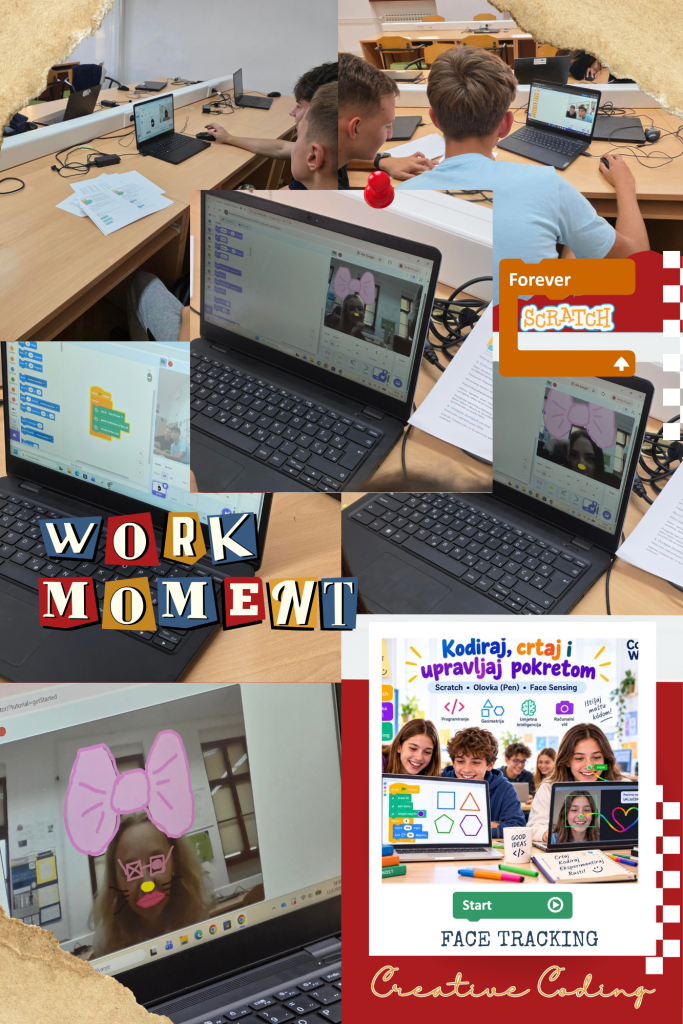
Using Scratch, first-year students connected mathematics and programming before taking their learning a step further: controlling a virtual pen using their own head movements.
Shared by Sanja Pavlović Šijanović, Leading Teacher for EU Code Week in Croatia, and Davor Šijanović of Vukovar Gymnasium, the activity offers practical inspiration for educators preparing for EU Code Week 2026.
Make code visible. Make learning interactive. Give students the freedom to experiment.
From geometry to code
The workshop began with a straightforward challenge: could students programme a character in Scratch to draw geometric shapes?
Using the Scratch Pen extension, students programmed a sprite to draw squares, equilateral triangles, pentagons and other regular polygons.
Through this hands-on activity, they explored key programming concepts including loops, events, movement and rotation. At the same time, they discovered how mathematical rules could be translated into programming instructions.
The turning angle needed to draw a regular polygon.
Rather than simply learning a formula, students could immediately test it. When their programme was correct, the sprite completed a regular geometric shape on screen.
If the result was not quite right, they could change a value, run the programme again and observe the difference.
Once they had mastered the initial shapes, students progressed to the challenge of creating a hexagon.
WHY THIS WORKED
Students could see the result of every programming decision immediately. Mathematics became something they could test, adjust and explore rather than simply calculate.
Drawing with your nose?
The next stage of the workshop introduced an unexpected challenge: students would use their own movements to control the programme.
By combining the Scratch Pen extension with Face Sensing, students used their cameras to detect the position of their noses.
As they moved their heads, Scratch moved the sprite accordingly, while the virtual pen left a trace of its movement.
Students experimented with drawing lines, geometric shapes, symbols and even letters, simply by moving their heads.
How do you draw a square?
Draw it with code
The sprite follows precise instructions, moving defined distances and turning through calculated angles to create a regular square.
Draw it with movement
The sprite responds to the student’s head movements, using camera input to control the virtual pen in real time.
Comparing the two squares helped students understand the difference between algorithmically determined movement and interactive control.
It also introduced plenty of laughter, friendly competition and creative experimentation into the classroom.
Experiment. Collaborate. Improve.
Throughout the workshop, students compared their solutions, helped one another and worked together to understand why particular shapes appeared differently from what they had expected.
Changing just one value in the programme immediately produced a visible difference on the screen.
Through repeated attempts, students quickly connected cause and effect. Errors became opportunities for testing, discussion and improvement.
The first-year students embraced the activity with great interest and enthusiasm, particularly enjoying the ability to see their code working immediately and experiment with new ideas.
Five ingredients that made the activity engaging
Students could see the results of their decisions directly on screen.
Mathematics, programming and computer vision came together in one activity.
Students could experiment, change values and develop their own solutions.
Sharing solutions and helping classmates became a natural part of the lesson.
Face tracking introduced an unexpected and entertaining way to interact with code.
By the end of the session, students were comparing drawings, discussing their solutions and suggesting new things they could create.
For some, the greatest challenge was drawing the most regular square possible. For others, it was writing their name using their nose.
What they all shared was the experience of discovering programming in a different, more immediate and more playful way.
Inspired? Try something similar in your classroom.
One of the most valuable aspects of the EU Code Week community is the opportunity to discover ideas from other educators and adapt them to suit your own learners.
Start with a simple challenge
Ask students to programme Scratch to draw a square, then progress to more complex shapes.
Connect coding with another subject
Explore geometry, art or science through practical programming challenges.
Make it interactive
Explore how movement or other inputs can control a programme.
Give students room to experiment
Encourage learners to test ideas, compare results and improve their code together.
You don’t need an elaborate lesson to make coding engaging. Start with an idea, make it interactive and let your students explore.
Make it your Code Week.
EU Code Week is celebrated across Europe from 10 to 25 October 2026, and everyone is invited to take part.
Whether you organise a classroom coding challenge, a creative Scratch workshop or a community event, your activity can help introduce more young people to coding and digital creativity.
Find your inspiration. Plan your activity. Add it to the map.
With thanks to our contributors
A special thank you to Sanja Pavlović Šijanović, Leading Teacher, EU Code Week – Croatia, and Davor Šijanović of Vukovar Gymnasium, Croatia, for sharing this creative classroom activity and inspiring other educators to explore new approaches to coding.
