Innovation from the Classroom: Vukovar High School Students Develop FlexiSOS
23/07/26
At a time when technology often becomes an end in itself, only a few projects manage to connect innovation so directly with real human needs as the students of Vukovar Gymnasium have done. Known for their achievements in STEM fields, these young students developed FlexiSOS, an inclusive assistive device designed to send emergency and everyday messages to people for whom smartphones and modern applications are difficult to access or too complex to use.
Technology built around real human needs
The development of FlexiSOS required the integration of knowledge from electronics, programming, IoT communication, and 3D modeling. At the heart of the project was a clear idea: to create a device that would provide users with greater safety, independence, and easier communication in both everyday and emergency situations.
During the process, the students explored the real needs of users and gained insight into the challenges faced by older adults and people with disabilities in moments when fast communication becomes essential.
How coding for accessibility shaped the design
The project naturally became part of EU Code Week, the European initiative dedicated to creativity, digital skills, and the use of technology within the community. Through their work, the students demonstrated that programming goes far beyond writing code and can become a powerful tool for solving real-life problems. The software they developed enables the device to send location data and emergency alerts even in situations where conventional mobile applications may not be reliable enough.
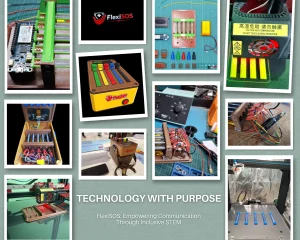
By participating in initiatives such as this, the students became part of a wider European network of young innovators using technology to create a more accessible and inclusive society. One of the project’s greatest strengths lies in its practical application. FlexiSOS uses an LTE network, allowing the device to remain functional even outside the range of Wi-Fi connectivity. The system is adapted for users with visual or motor impairments, and it operates independently from smartphones. During development, the students gained hands-on experience working with hardware components, sensor systems, and power stabilization, while also designing the device casing through 3D modeling.
Ergonomics played an important role, leading to the creation of large, clearly visible, and easily recognizable buttons. An additional level of accessibility is provided through Braille labels integrated into the device buttons. Alongside clearly separated and color-coded controls, each function also includes a tactile marking, enabling blind and visually impaired users to recognize commands by touch. In this way, Braille becomes an essential part of the device’s functionality, offering users greater independence, safety, and the ability to react quickly when assistance is needed.
Learning like a real engineering team
From the initial idea to final testing, the students participated in every stage of development. The project enabled them to acquire technical knowledge while strengthening teamwork, organizational skills, and collaborative problem-solving abilities. Each phase required adaptation, analysis, and decision-making similar to the work of a professional engineering team, while also encouraging a stronger awareness of social responsibility and human-centered technology.
Working on the device also introduced the students to a research-oriented approach rarely encountered in regular classroom teaching. They analyzed system stability, sensor precision, and communication reliability in real-world conditions while exploring ways to improve battery life and power stability.
This process brought them closer to real engineering practices and demonstrated the importance of knowledge, responsibility, and collaboration in the development of technology intended to help people.
Why FlexiSOS matters
FlexiSOS demonstrates how far the knowledge, curiosity, and responsibility of young people can reach when they are given the opportunity to develop their own ideas. In the hands of Vukovar’s students, digital tools became a means of creating practical support and meaningful positive change. The device stands as a reminder that technology achieves its greatest value when it is focused on people, their safety, independence, and dignity.
By Sanja Pavlović Šijanović (Leading Teacher, EU Code Week – Croatia) and Davor Šijanović (Vukovar Gymnasium, Croatia).
