




CodyColor KIT

Scientific author: Alessandro Bogliolo - EU Code Week Italian ambassador; University of Urbino
Contributors and testimonials: Fabrizia Agnello, Carmela Cundari, Alfonsina Cinzia Troisi - EU Code Week Italian Leading Teachers
Instructional design, project management, internationalisation: Veronica Ruberti - EU Code Week Italian HUB Coordinator; Fondazione LINKS
Internationalisation and translation: Lucia Terrone - EU Code Week Italian HUB Coordinator; Fondazione LINKS
This resource is developed in collaboration with CodyRoby Academy
CodyColor is an unplugged coding method (without the use of electronic devices) designed by Alessandro Bogliolo, professor of Information Processing Systems at the University of Urbino, aiming at lowering barriers to practice computational thinking. Based on extremely simple rules, CodyColor can be introduced from early childhood education, but also supports challenging activities for lower/upper secondary school and adults.
In this kit you'll find thorough explanations of the principles and potential of the CodyColor method, concrete proposals for teaching activities using the kit to promote computational thinking skills, and detailed guidelines to create the tools and bring the activities into your classroom.
Who is the CodyColor KIT for?
CodyColor KIT is aimed at teachers of all school levels and educators. It can be applied in formal and informal learning contexts, complementing both STEM and humanities because it strengthens:
- Logical thinking and computational thinking
- Spatial orientation and rotations
- Strategy development, comparing hypotheses, and group decision-making
- Collaboration, communication, and respect for rules
CodyColor KIT is aimed at families because unplugged coding activities can be carried out playfully outside formal learning contexts, are engaging, require no prerequisites, no specific equipment, and are suitable for all ages.
Why discover, experiment with, and learn the CodyColor method?
- Unplugged ⭢ No digital device required ⭢ Highly accessible
- Color-based ⭢ Multilingual ⭢ International collaboration
- Versatile ⭢ Different ages ⭢ Cross-age collaboration
- Multidisciplinary ⭢ Interdisciplinary collaboration ⭢ Community activation
How does this kit work?
In this page you will discover the CodyColor method through an asynchronous training path in small, sequential, easy-to-follow steps, using accessible language. Every step is a downloadable PDF, designed to be easy to print and use in class, containing theoretical background, lesson outlines, activity descriptions, facilitation prompts, and guidelines for teachers.
The objective is to guide you from learning the methods to applying them in the classroom, from learning to teaching with the CodyColor lesson plans as scaffolding materials.
Let's start!
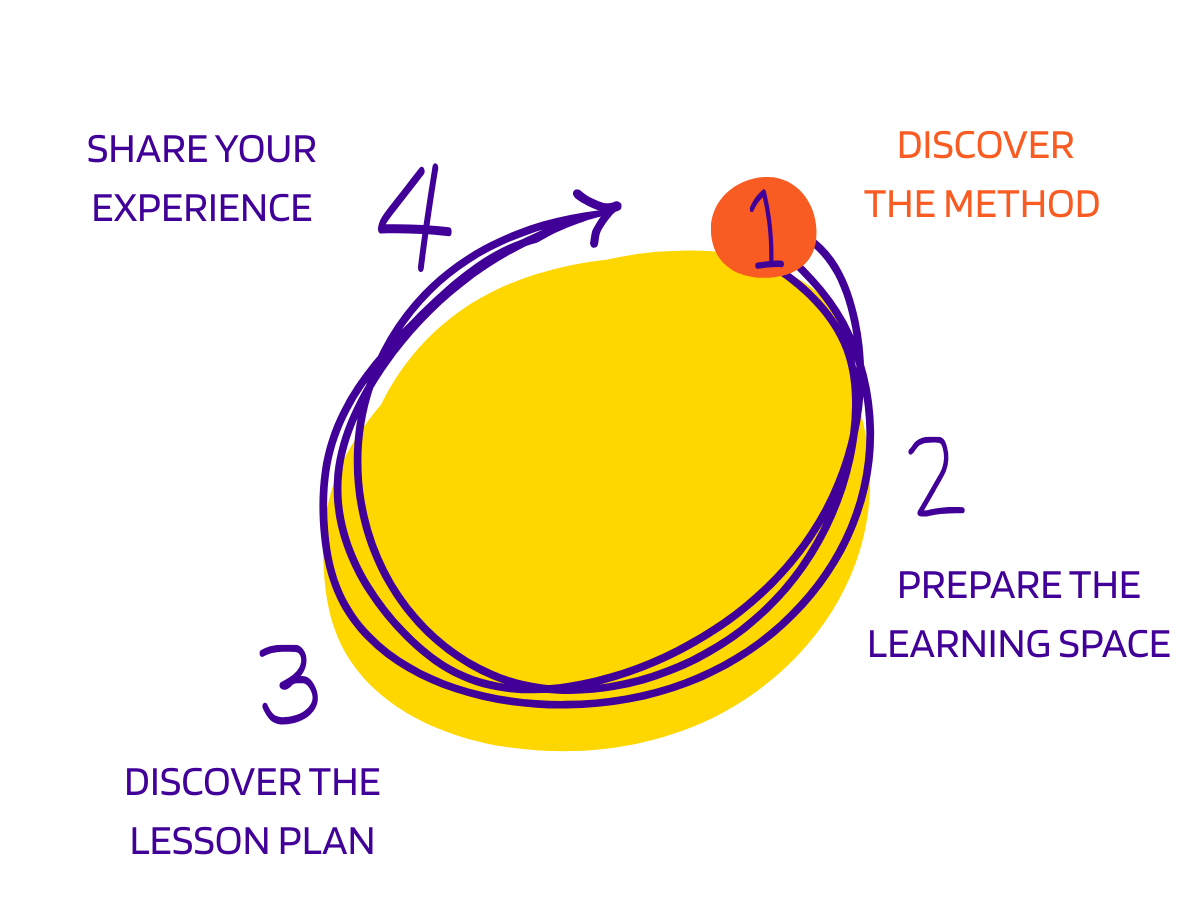
In these learning bits you will:
Contacts
For information, curiosities, and insights contact: codeweek@linksfoundation.com
Every time you run a CodyColor challenge in class, during a school event, a team building, or a training course, register it on the map of the European Code Week. Every organizer will receive a participation certificate for their commitment and will contribute to a campaign raising awareness of the importance of computational thinking skills.
If you want to get in touch with an international group of enthusiastic teachers, sign up for the EU Code Week teachers' Facebook group! To take a further step and collaborate with other schools in your country or across borders, join the Code Week 4 All challenge.

Copyright notice
The EU Code Week website is a service supported by the European Commission
Except where stated otherwise, content made available on this site is licensed under a Creative Commons Attribution-NonCommercial-ShareAlike 4.0 International (CC BY-NC-SA 4.0) license
Licensing under Creative Commons licenses does not of itself affect the ownership of the copyright
Content from third party websites is subject to their own copyright restrictions; please refer to the site of origin for more information.