EU Code Week Activity Tags: How to Choose the Right One
04/10/26
EU Code Week 2026 is almost here! From 10–25 October, educators, schools, organisations, companies and community members will come together across Europe to create opportunities for people to discover coding, digital skills and technology.
Code Week happens locally, in classrooms, libraries, workplaces and community spaces. Adding your activity to the EU Code Week map makes those local efforts visible. Choosing the right tags makes your activity easier to discover and showcases the many ways the Code Week community brings coding and digital skills to life across Europe.
Before registering, think about your activity’s main purpose, format and duration. Here is a quick guide to four activity tags. And don’t forget that you can choose more than one tag for your activities!
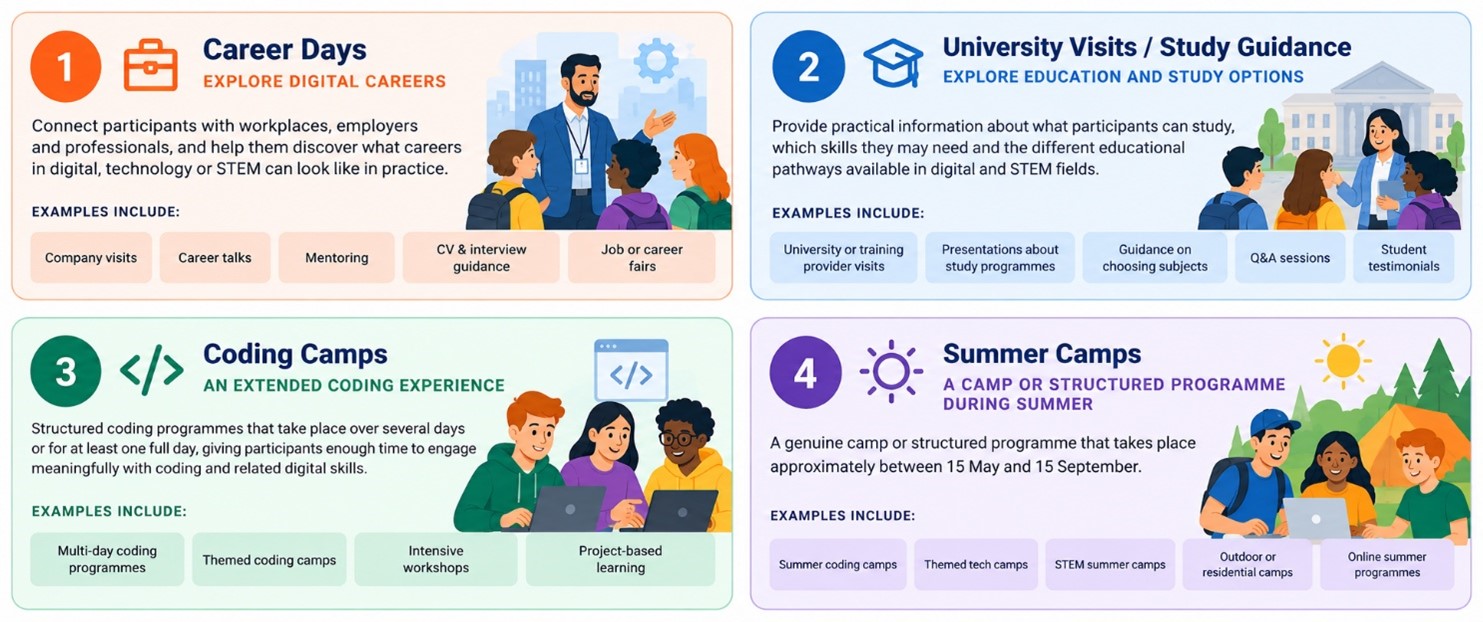
Career Days: bringing digital careers closer to young people
Is your activity designed to help young people explore future careers in digital, technology or STEM?
Then Career Days may be the right tag.
Career Days connect participants directly with workplaces, employers and professionals, giving them an opportunity to discover what careers in these sectors can look like in practice.
A Career Day activity could be:
- a visit to a local company, where young people discover different digital roles and experience a real working environment;
- a career talk or employer visit to a school, where professionals share their career journeys and experiences;
- a mentoring activity, connecting participants with professionals for individual or group guidance;
- career navigation support, such as CV guidance, interview preparation or information about roles in the digital and STEM sectors;
- a regional or national Career Days programme, workshop or conference organised with companies;
- a job or career fair, bringing employers together with students or job seekers. This can include Digital or STEM Career Fairs, school- or university-based job fairs, Women in Tech job fairs and virtual career fairs.
The key question: Is the activity primarily helping participants explore careers, meet employers or professionals, and better understand opportunities in the workplace?
University Visits: helping learners decide what comes next
Some activities focus less on employment and more on helping young people understand their education and study options.
For these activities, choose the University Visits tag.
These activities provide practical information about what participants can study, which skills they may need and the different educational pathways available to them in digital and STEM fields.
They can include:
- visits to universities or training providers;
- presentations about university, vocational education or alternative pathways such as bootcamps;
- guidance on choosing subjects or study programmes;
- information sessions with universities, training providers or companies;
- interactive Q&A sessions about applications, studies and future opportunities;
- testimonials from students and young professionals about their education journeys.
Here, the distinction from Career Days is important.
Career Days are primarily about exploring professions and the world of work. University Visits and activities are primarily about understanding education and study pathways.
For example, if students visit a technology company to meet software developers and discover what their jobs involve, Career Days is likely the appropriate tag.
If students visit a university to learn about its computer science programmes, entry requirements and study options, choose University Visits.
Coding Camps: more than a single coding session
Planning an immersive coding experience? Your activity may qualify as a Coding Camp, but duration matters.
Coding Camps are structured coding programmes that take place over several days or for at least one full day.
A two-hour coding workshop, for example, is a valuable Code Week activity, but it should not be registered as a Coding Camp.
Ask yourself: Is this genuinely an extended coding camp or programme rather than a one-off workshop or short activity?
Summer Camps: both the format and timing matter
A Summer Camp is not simply any Code Week activity that happens during the summer.
To use the Summer Camp tag, your activity should genuinely be organised as a camp or structured programme and should take place approximately between 15 May and 15 September.
Think about both when your activity takes place and how it is organised. If it is a genuine camp or programme taking place during the summer period, the Summer Camp tag is appropriate. If it is a standalone workshop, event or short session, choose another tag that better reflects the activity.
One activity, the right description
The important thing when registering is to describe what you are actually organising and choose the tags that genuinely match the activity.
Before submitting your activity, check:
- Career Days → Is the main focus on careers, workplaces, employers, professionals or career guidance?
- University Visits → Is the main focus on education pathways, study choices and understanding what or where to study?
- Coding Camps → Is it a genuine extended coding programme lasting at least one full day, approximately six hours or more, or several days?
- Summer Camps → Is it genuinely a camp or structured programme taking place approximately between 15 May and 15 September?
If the activity does not meet one of these definitions, that is absolutely fine.
Do not select a tag simply because it seems close to your activity.
Choose the options that best describe what participants will actually experience.
Other tags to consider
Depending on your activity, you can also choose:
- Weekend Course: for courses held at weekends.
- Evening Course: for courses held in the evening.
- Coding@Home: for activities using the Coding@Home resources ,including short videos, puzzles, games and coding challenges for families and schools.
- Code Week Challenge: for activities using the EU Code Week challenges, with practical guidance you can adapt to your participants’ ages and interests.
- Competition: for activities organised as a competition.
- Other (e.g. Group Work, Seminars, Workshops): for activities such as group work, seminars or workshops that are not covered by the other tags.
For example, a coding camp held in summer could use both Coding Camp and Summer Camp. Choose all the tags that accurately describe your activity.
Put your activity on the map!
Need a quick refresher on how to add an activity? Watch this short video on creating an activity on the EU Code Week platform.
With EU Code Week 2026 taking place from 10–25 October, now is the time to add your activity, choose the tags that best describe it and help us build an accurate picture of everything happening across the Code Week community.
Register your activity on the EU Code Week map and help us show what the community can achieve together.
