How coding is helping students care for the world around them
20/05/26
Today we travel to Greece to share the inspiring story of Marina Zacharia, who is proving that even kindergarteners can use coding and micro:bits to protect nature and build deep empathy for the world around them.
At the 1st Kindergarten of Lagyna, Thessaloniki, Marina Zacharia is introducing children aged 4 to 6 to coding through play, storytelling, and real-world challenges.
Using tools like micro:bit and simple sensors, Marina and her students created smart constructions designed to help plants and animals, including smart watering systems, animal feeders, and fire protection systems for wildlife. Through these activities, coding became a way for children to explore empathy, sustainability, and problem-solving.
“Our students were incredibly excited to discover that technology can be used not only for games and entertainment, but also to help living things and protect the environment,” Marina told us.
When plants “ask” for water
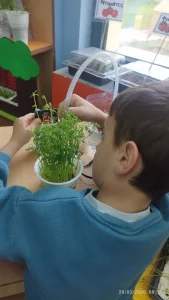
One of the projects that captured students’ imagination was a smart watering system built using moisture sensors.
“Children observed how the moisture sensor detected when the soil was dry and activated watering automatically,” Marina said. “They were fascinated by the idea that ‘the plant can ask for water’.”
Rather than simply learning coding commands, students began to understand how technology could respond to real needs.
“The coding process became meaningful because it was connected to empathy and real environmental issues,” she explained. “Children were not simply learning commands or programming sequences; they were using technology with a purpose.”
That sense of purpose encouraged students to collaborate, test ideas, and solve problems together.
A classroom idea inspired by wildfires
Some of the most memorable moments came from the children’s own ideas and questions.
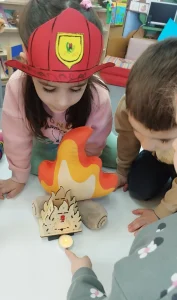
During a project focused on forest fire protection, the class mascot – Kallisto the bear – became part of a discussion about how wildfires destroy animal habitats.
“The children became deeply concerned about how forest animals could stay safe,” Marina recalled. One student then asked: “Can we make a nest that protects the animals by itself?” “That simple question inspired the creation of our smart fire protection system,” the teacher said.
Students began suggesting increasingly creative solutions, including flame sensors, warning sounds, and automated water systems.
“What amazed us most was how naturally they connected technology with empathy and real-life needs. When children are given meaningful challenges connected to the real world, their creativity and problem-solving abilities can go far beyond our expectations.”
Inspiring both students and teachers
Beyond the classroom, Marina also works as a Leading Teacher supporting hundreds of schools across Greece and Europe through Code Week initiatives.
“What continues to inspire me about Code Week year after year is seeing how coding and STEM activities can transform children’s confidence, creativity, and way of thinking from a very early age,” she said.
Marina has been recognised in Brussels as a top EU Code Week Leading Teacher – an experience she says strengthened her commitment to helping other educators embrace innovation in the classroom. “What motivates me most is watching students – and teachers – gain confidence and realise that they can create, experiment, and actively participate in the digital world. Every year, Code Week builds stronger communities of educators who inspire one another, share ideas openly, and bring meaningful innovation into their classrooms.”
From turning a classroom mascot’s worries into a smart wildfire protection system to mentoring hundreds of educators across Europe, Marina’s work beautifully illustrates the true spirit of EU Code Week. She proves that when children are empowered with technology early on, they don’t just learn to program—they learn to care, collaborate, and build a safer, greener future.
