
Coding, teamwork and digital skills: A conversation with Krist Fama
23/03/26
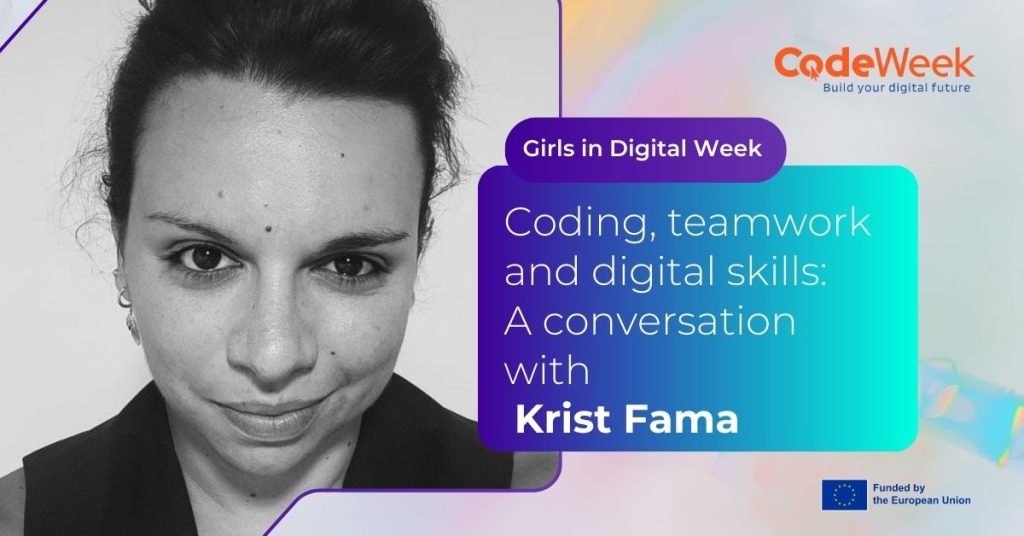
As part of Code Week’s Girls in Digital campaign, we are highlighting women who are helping shape the digital world and encouraging the next generation to explore coding and technology.
Krist Fama is a computer scientist with a strong interest in artificial intelligence and agile teamwork. She enjoys bridging the gap between technical experts and decision-makers while building solutions that make everyday life easier.
She shares with us her perspective on coding as a tool for problem-solving, the importance of collaboration in tech, and why more girls should feel confident stepping into the world of digital innovation.
Coding is about solving problems, not being perfect
Q: When you first started coding, what helped you realise that coding is less about being “perfect” and more about problem-solving?
KF: I realised early on that coding is less about perfection and more about problem-solving when I noticed that the hardest part of any task wasn’t writing the syntax, but deeply understanding the logic.
I often found that once I had spent enough time deconstructing the “why” and “how” of a problem, the actual implementation became straightforward. It reminds me of Einstein’s philosophy: if he had an hour to solve a problem, he’d spend 55 minutes defining it. In my workflow, the coding is those final five minutes – the execution of a well-thought-out plan.
Q: As a girl in tech, did you ever feel the need to prove your technical skills more than others? How did you build your confidence in your coding abilities?
KF: Early on, I did feel a pressure to prove my technical skills, but I eventually shifted my focus from seeking approval to delivering results. I realised that if my code is clean, my logic is sound, and the software solves the problem, the work speaks for itself.
My confidence grew through a “fail-forward” mentality. I stopped fearing mistakes and started seeing them as data points; every bug I fixed added a layer to my foundation, eventually turning my technical competence into genuine confidence.
Teamwork and communication are central to tech
Q: Many girls worry that coding means sitting alone in front of a screen all day. From your experience, how important are teamwork and communication in coding-related roles?
KF: I’d actually link this back to my earlier point: if coding is 90% problem-solving, then communication is your most valuable diagnostic tool. You can’t solve a problem effectively in a vacuum.
The best way to deconstruct logic and gain fresh perspectives is through dialogue – whether that’s over lunch, during a walk, or in a formal brainstorm. I’ve found that teamwork doesn’t distract from the “real work”; it is the real work. Once the collective logic is sound, sitting down to write the code is just the final, solitary step of a very social process.
Q: Why is learning to code such a powerful skill, even for those who may not become full-time programmers?
KF: I see coding as a superpower of self-sufficiency. Even with AI tools doing much of the heavy lifting today, the true skill lies in the logic and the ability to oversee what the AI produces.
If you know the foundations, you can combine your creativity with these tools to become incredibly efficient. It’s about not having to wait for a solution to appear in the market – if I need a tool to make my life or someone else’s life easier, I can just build it. It makes the world feel limitless because you’re no longer a consumer of technology; you’re a creator.
Girls in tech can help shape the future of AI
Q: With AI becoming part of everyday technology, what should girls learning to code today understand about their role in shaping how these technologies affect people’s lives?
KF: AI is changing the world, but as girls in tech, we are the ones who determine how it changes. Our role is to bridge the gap between what AI can do and what it should do. By mastering the code, we gain the authority to challenge biased systems and build tools that actually solve diverse problems. It’s about ensuring that the future of technology reflects everyone, not just a few.
Q: If you could speak directly to a girl taking part in Code Week who is unsure whether coding is “for her”, what would you tell her?
KF: You’ll never truly know until you try it for yourself. Coding isn’t a test you pass or fail; it’s an experience you explore. Give yourself the chance to get curious and figure it out as you go – you might just surprise yourself with what you’re capable of building!
Ready to inspire more girls to explore coding and digital skills?
Take part in Girls in Digital through Code Week and help show that technology is for everyone.
