EU Code Week Hackathon Greece
05/01/26
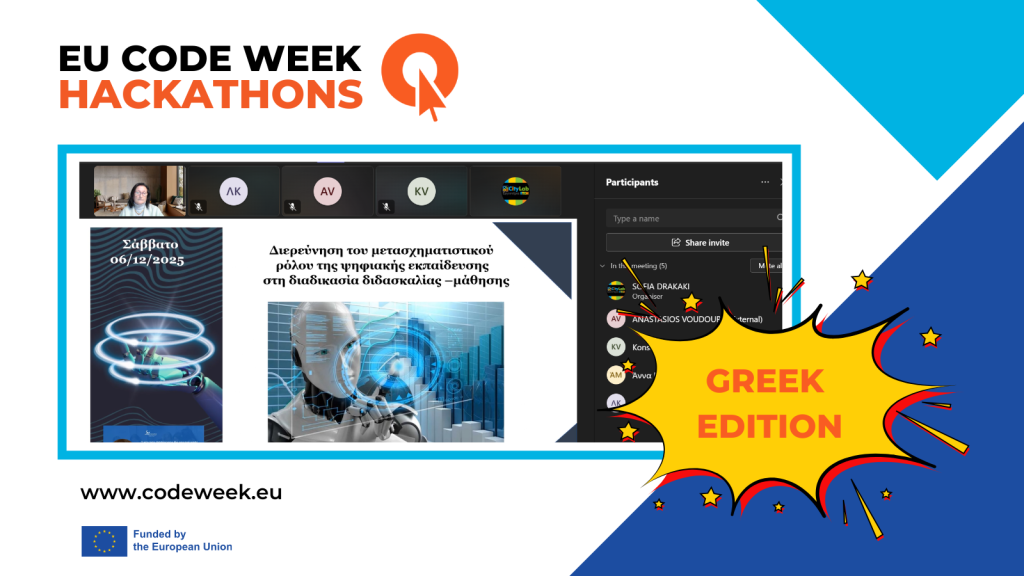
On 6–7 December 2025, the Greek EU Code Week Hackathon brought together young innovators for a weekend
fuelled by coding, collaboration, and creative problem-solving. With five teams competing, the energy was high from the very start — and the focus
was clear: designing meaningful digital solutions for a theme that impacts students directly.
A challenge close to home: improving education
This year’s hackathon theme, Challenges in the Education Sector, invited participants to look critically at how learning happens today
and imagine what could be improved. Over two days, teams worked intensively to develop ideas, shape prototypes, and prepare presentations — supported
by mentors who played a crucial role throughout the weekend.
In fact, the mentoring spirit became one of the strongest takeaways of the event. Mentors stayed on-site well past the scheduled end of Day 1,
ensuring teams had the guidance and encouragement they needed to push their ideas further.
“Groundbreaking.” This was the shared reaction from the jury when reflecting on the overall quality and originality of the ideas presented.
A standout moment: sharing solutions before the results
One of the most memorable moments happened while the judges were deliberating. Instead of waiting quietly, the teams gathered for an informal
presentation session — a relaxed space where participants could interact, bond, and share their approaches with one another before the official
announcements were made.
The session captured what Code Week hackathons do best: they are not only about competition, but also about community — building confidence,
encouraging peer learning, and giving young people a supportive environment to test ideas out loud.
One student summed up his team’s vision with a powerful elevator pitch:
“I want to change the way lessons are conducted so they are interesting for everyone, and there is no need for STEM activities outside of school.”
It was a reminder that students often know exactly what needs to change!
Judges, mentors, and community support
The event featured a distinguished panel of judges and mentors representing the Ministry of Digital Governance,
the University of Piraeus, Renesas Electronics, AI Catalyst, the Greek Code Week Hub,
CityLab, UniSystems, and the Athena Research Center.
The Greek Code Week Community was also represented by Anna Magkiosi, Code Week Leading Teacher, who contributed as a judge —
reinforcing the strong connection between Code Week’s educator community and the young people at the heart of these events.
Winning team: Curiosity Street
Team Curiosity Street took first place with their project Nexus — a platform designed to gamify education
and support students learning through riddles and puzzles, while collaborating in groups.
At the core of Nexus is a clear educational philosophy: shifting learning towards Project-Based Learning and evolving the educator’s role
from a traditional instructor to a mentor and guide. It’s an approach that aligns strongly with the hackathon theme, proposing a practical way
to make lessons more engaging, collaborative, and meaningful for students.
Congratulations to Curiosity Street — and to every team who participated and helped prove what’s possible when young people are given the space
to create, test, and present solutions that matter.
Ready to host your own Code Week hackathon?
Code Week hackathons are a powerful way to bring students, educators, mentors, and local partners together around real-world challenges.
If you’re thinking of organising one in your school or community, our toolkit can help you plan, run, and promote your event.
