Exploring how AI is reshaping education in North Macedonia
20/04/26
As part of the project “Code for the Future – AI and Digital Skills Hub”, implemented within the framework of EU Code Week and supported by JA Europe and the European Commission, the Association for Education Edu Skills from Kriva Palanka continues to create spaces where teachers, experts and institutions can reflect together on the future of learning in the digital age.
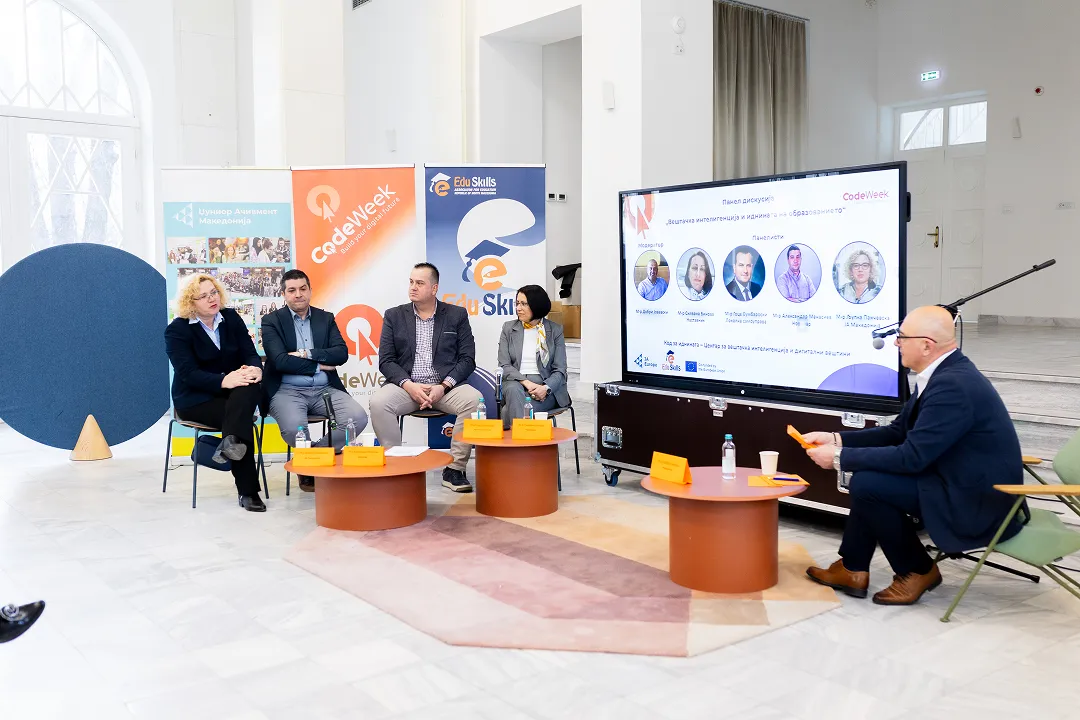
One of these important activities took place on 18 March 2026 at Europe House Bitola, where the panel discussion “Artificial Intelligence and the Future of Education” brought together teachers, institutional representatives, local stakeholders and education practitioners to discuss one of the most important questions for today’s schools: how should education respond to the growing presence of artificial intelligence?
The event was organized as part of the wider Code Week vision of promoting digital skills, innovation, computational thinking and responsible use of technology. While many Code Week activities focus on coding and hands-on classroom practice, this panel created an opportunity to go a step further to discuss how emerging technologies such as AI are changing teaching, learning and the role of schools in preparing young people for the future.
A timely conversation for teachers and schools
The discussion highlighted that artificial intelligence is no longer a distant or abstract topic. It is already entering classrooms through digital tools, content generation platforms, personalized learning support and new ways of accessing information. For this reason, teachers increasingly need not only technical awareness, but also pedagogical confidence and ethical guidance.
Silvana Binova, a mathematics teacher with practical experience in using AI tools in education, shared reflections from everyday teaching practice. Her contribution emphasized that students are often very quick to adopt new technologies, which makes the role of the teacher even more important in guiding their use in meaningful, critical and responsible ways.
A strong focus was also placed on media literacy, critical thinking and the need to help students distinguish between reliable information and manipulated or AI-generated content. In this context, Aleksandar Manasiev from Narativ AI – Center for Media Innovations in the Balkans stressed that modern education must prepare students not only to use digital tools, but also to question them, evaluate information and act responsibly in an increasingly complex information environment.
Why this matters for Code Week
At its core, Code Week is not only about learning to code. It is also about developing the mindset and skills needed to live, learn and work in a digital world. This includes creativity, problem-solving, collaboration, digital citizenship and critical engagement with technology.
The panel in Bitola reflected exactly these values. It opened discussion on how schools can move beyond simple technology adoption and instead focus on purposeful and ethical use of digital tools. Participants discussed how assessment methods may need to evolve, how trust between teachers and students can be maintained, and how education systems can support both innovation and responsibility.
For Association for Education Edu Skills, this event was a natural continuation of the project’s broader work with teachers and students across North Macedonia. Through workshops and practical classroom activities, the initiative has already supported the development of AI literacy, coding skills and digital confidence. The panel added another important dimension by connecting classroom experiences with broader educational, social and policy perspectives.
Bringing together local voices and shared responsibility
The discussion also showed how important collaboration is when it comes to shaping the future of education. Dobri Jovevski from Edu Skills highlighted the value of practical support for teachers through training sessions, classroom-based activities and local engagement. Goce Bumbaroski, representing the local education sector, underlined the importance of institutional cooperation and long-term support for digital development in schools. Ljupka Panchevska, Director of JA Macedonia, emphasized that initiatives like this help young people build the practical digital and entrepreneurial skills they will need in the future labour market.
This exchange of perspectives made the event especially valuable. It showed that the future of education cannot be shaped by schools alone. It requires cooperation between teachers, organizations, institutions and communities — something that is fully in line with the spirit of Code Week.
Looking ahead
The panel discussion in Bitola was more than a standalone event. It was part of a growing effort to support teachers and students in North Macedonia as they navigate rapid technological change. By combining practical learning activities with open dialogue and community engagement, the project “Code for the Future – AI and Digital Skills Hub” continues to strengthen the local Code Week ecosystem and encourage a more confident, inclusive and future oriented approach to digital education.
As technology continues to evolve, one message from the event stood out clearly: education must evolve too not only by adopting new tools, but by helping learners and teachers use them with understanding, responsibility and purpose.
